
Course Review: “EMC Filter Design to Pass the EMC Test” – Biricha Digital
Hello folks, James here.
I recently (December 2025) travelled to Munich to participate in the Biricha Digital course titled “Power Supply Input EMC Filter Design for EMC Compliance“. I found the course to be very interesting and worthwhile. There was some interest from fellow engineers on LinkedIn for this course and for a review of some kind. So here you go.
Overview
The course was designed by Dr. Ali Shirsavar and ably delivered by Dr. Michael Hallworth. I’m not going to list the topics in detail, you can find those on the course page.
I found Michael to be pretty good presenter, but then I had the advantage of siting near the front and having a reasonably good command of English 🙂 Being held in Munich there were a large number of native German speakers (Austria, Munich, Stuttgart) so I can’t comment on how well they understood the verbal side.
One thing I particularly liked about the course was the change between theory (slideshow) and practical (lab exercises). Working on the principle that you learn in three ways – “watch one, do one, teach one” – this approach covered the first two well. The lab exercises also break up the need to constantly focus on slides and presenter.
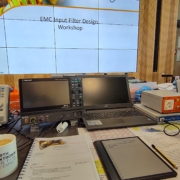
Another bonus was the well equipped work stations. Working in pairs (I sat next to a friendly German engineer named Tim) we had access to Siglent oscilloscope and spectrum analyser, a Omicron Bode 100, a 50uH LISN (all low voltage powered, for safety), and a laptop preloaded with all of the software and apps we needed.

Working in pairs provides an interesting dynamic. Invariably two people will have picked up different things from the course and have different backgrounds and understanding. Working together allows these experiences to combine, hopefully complementing each others knowledge. It also gives you a partner for accountability – if they are relying on you to perform a measurement for the next stage of the design then you can’t just sit there and let them do all the work!
The pre-made PCBs for each exercise comprised DC/DC power converters in different topologies, load boards, filter boards, etc, with each one designed for a different lesson. This made the practical sessions very straightforward.

What I found most interesting or relevant as an EMC engineer
- Focus on designing a Differential Mode (DM) filter to attenuate the first “in-band” harmonic to meet the conducted emissions limit. Because the DM harmonics for a rectangular/trapezoidal (or similar) pulse roll off at 20dB/decade, once the first one passes the rest are likely to follow.
- The effect of the output LC filter of a flyback converter on loop stability
- Guidelines for simulating or estimating magnitude of DM harmonics
- The use of impedance paper for designing a filter – both quick and effective
- The effect of source inductance (LISN) on conducted emissions and stability – generally minimal but worth considering for its effect on low frequency stability margin
- Thinking about the power supply as a current ripple source rather than a voltage source
- The effectiveness of a small capacitor to make a Pi filter
- Designing for CMC leakage inductance for DM filtering
- Locations for line-to-chassis capacitors
- AC/DC converters and their relatively high Middlebrook stability threshold
- PFC boost converter spectra and filtering
- Order of component parameter selection for an AC/DC converter being different to that of a DC/DC converter – safety first, literally!
What I would have liked more of
The course applies the 80/20 rule giving general guidance, shortcuts (impedance graph paper), and a design methodology that gets you 80% of the way to a working filter with only 20% of the effort.
I would have liked more time to explore the remaining 20% of the work (yes, I know, for 80% of the effort) including:
- Exploration of other damping techniques
- Simulation of CM filters including parasitic elements
- What happens outside of the ideal / design compromises
- CM noise estimation and simulation
- Frequency dependant or lossy core material and effects on filters
I appreciate that a lot of this isn’t possible or practicable for a 2.5 day course. I guess the learning never does stop…
Venue
Wurth Elektronik in Freiham, Munich.
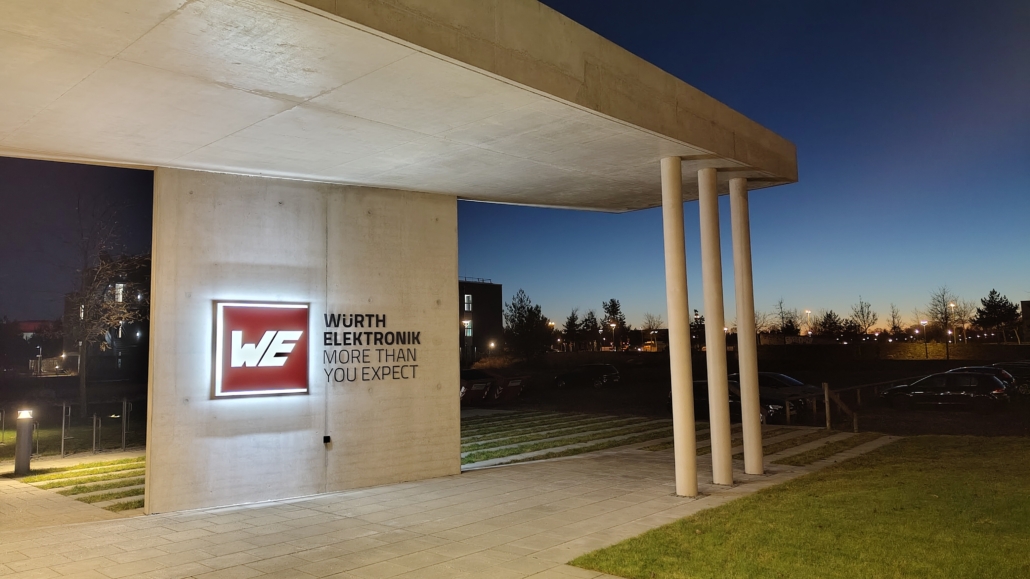
There is a hotel immediately adjacent to the building but Freiham is well served by regular S Bahn train services S5 and S8 (the airport train) from the city centre. There are lots of hotel and restaurant choices in the centre plus you are closer to the attractive Old Town area. Munich airport is as pleasant as airports get and is only a 30 minute train from the city centre.
I made some time to visit the Christmas markets (bratwurst, glühwein, germknödel) and for a trip to the excellent Pinakothek der Moderne art museum. I also managed to see visit my friends and fellow consultants at the Denpaflux office for a catch up.
The lecture theatre is well equipped with large displays and a microphone for the presenter. The coffee and tea were hot and good quality, snacks were plentiful and the canteen lunches were delicious.
“In person” training vs. “virtual” training
I am a big fan of in-person training, both in terms of attending and delivering. I made a decision to only teach my Think EMC courses in person for this reason.
As an attendee there are several things I personally like about this style of course, mainly because it suits my learning style.
- Dedicated time – I find it takes me about an hour to “upload” information to my brain before I can start working on it or connecting points together and coming to an understanding. I strongly dislike “context switching” as I often have to start again. Having a few days of dedicated time to commit to a subject gives me the chance to learn more deeply.
- Distractions – scenario: I’m taking a virtual course on my laptop when “bing” an email arrives, “pop” a Slack message that I could reply to, “hello” a colleague has arrived to ask a question. How much time am I spending on the course? Am I really learning in a high quality way?
- Questions – It is easy to not understand something the first time it is presented. If you pay attention to the room as a teacher you can see when something doesn’t land well or get understood. The ability to ask questions as they occur and to clarify your understanding is key. The only stupid question is the one you don’t ask.
- After course discussions – these are my favourite part of learning or teaching where you get to pick the brain of the teacher with your specific examples of the products that you might be working on at that time. I will happily stay for a couple of hours after my courses to help people apply what we’ve covered to their products.
- Hands on / demos – unless it is a particularly sophisticated online course the ability to work with real hardware and measurements is a very powerful learning technique.
Closing Thoughts
As someone who last designed a flyback power supply around 20 years ago (goodness me! And that was mostly following pre-made calculation sheets) it was good to get a solid refresher on stability criteria and filter theory. EMC specialists may not have this as part of their skill set.
If you are mostly integrating pre-designed AC/DC power supplies into your products then this course probably isn’t for you as most of this would be taken care of by the power supply vendor.
If you are only designing small point-of-load DC/DC converters up to 10W (fed from a AC/DC or larger DC/DC converter) then you would find this first half of this course very interesting (certainly with regard to stability), but without specific conducted emissions limits to meet it (and the rest of the course) might not be as applicable as you would like.
If you are designing your own AC PFC, AC/DC converters, or especially DC/DC converters that are the first point of contact in a system where conducted emissions requirements apply (think 12V automotive, 28V aerospace) then I would regard this course as very important for successful designs.
As an EMC engineer with a wide range of designs that turn up at my laboratory door I thought the course was excellent and I thoroughly enjoyed it. This course would be well worthwhile for anyone working in design for EMC.
My Score: 8.3 / 10 – I would recommend this course
