EMC Immunity – Commercial or Industrial? – EMC Explained
EMC Immunity Environments
The required noise resistance of our equipment, its “immunity”, is dictated by the electromagnetic environment that it is operating in.
In this article we look at the commercial EMC requirements for immunity to noise and the different environments that our equipment could find itself in.
The single biggest confusion we see with our customers is the difference between Commercial/Light Industrial on one hand and Industrial on the other hand. This guide covers this in some detail with examples.
This is a follow on article from our blog on EMC Emissions where we discussed the difference between Class A and Class B environments.
Why Immunity?
The emissions from our system can be viewed as a regulatory issue.
Access to the EM spectrum is regulated and controlled by government agencies. The expectation of the spectrum user is that the slice of spectrum that they have been allocated will be usable for the intended purpose and relatively noise free. The regulating agency generally has some kind of statutory or legal powers to deal with reported interference.
The immunity of our system can be viewed as a product quality issue.
If EM noise affects our system the perception of the user is that the system just doesn’t work correctly. Often the user has no way of knowing that EM noise might be the culprit, all they can see is poor performance.
It leads to scenarios like this:

“…won’t connect, just crashes randomly, would not buy again” – Amazon reviewer
“your equipment is faulty it keeps giving the wrong reading… please send an engineer” – email to service department
For mission or safety critical systems good EM immunity can be the difference between life and death. Medical devices, rail, automotive, military all have much higher immunity levels that equipment needs to comply with.
Typical Commercial EM Environments
Commercial (i.e. not automotive or military) standards split the electromagnetic environment into the following categories:
- Residential
- Non-Residential, made up of:
- Commercial
- Light Industrial
- Industrial

Examples of these environments and application of the Generic EMC standards are given in the below table.
| Residential / Domestic | Commercial / Light Industrial | Industrial |
| EN 61000-6-3
Residential, Commercial, Light Industrial (RCLI) |
||
| EN 61000-6-8
Commercial, Light Industrial (CLI) [1] |
||
| EN 61000-6-4
Industrial (Class A) |
||
| House
Apartment / flats
|
Light industrial, Workshops, Service Centres, Commercial Garages | Factory
Steelworks Heavy industrial plant Chemical works |
| Retail, Shops, Supermarkets | Power Plant
Power Substation |
|
| Business Premises, Offices, Banks, Warehouse | Wind Turbine, Solar Farm, Medium/Large Scale Renewable Energy Generation | |
| Public Entertainment, Cinemas, Indoor Sports Centre, Amusement Centre, Public bars, Sports Stadium, Places of Worship | ||
| Outdoor locations, Petrol stations, Car parks, Sports Ground, Farms (but not Farmhouse) | ||
| Hospital, Healthcare | ||
| Bus Station, Railway Stations, Airport, Transport Infrastructure | ||
| Schools, Colleges, Universities, Educational Establishments | ||
| Basements, Control Rooms, Electrical Service Areas | ||
Notes:
[1] whilst EN 61000-6-8 is not yet a Harmonised Standard it is available for use for CE marking. The only restriction is that it does not give an automatic Presumption of Conformity, requiring a small amount of internal paperwork on the part of the manufacturer to justify its application.
What is the difference between Commercial / Light Industrial and Industrial EMC environments?
Some important characteristics in making the decision between Commercial / Light Industrial and Industrial EMC immunity environments are outlined in the below table
| Commercial / Light Industrial | Industrial |
| City centre, retail park, business centre or units. Either a separate building or multiple units within the same building. | Dedicated factory building. |
| Power consumption of individual pieces of equipment is generally less than 10kW (low power) | Power consumption of individual pieces of equipment will likely exceed 20kW (medium to high power) |
| Potentially large quantities of individual low to medium powered electronic and electrical equipment | Large quantities of medium to high powered electrical equipment operating simultaneously |
| No such equipment | Operation of equipment that generates RF for Industrial, Scientific, or Medical purposes
Examples: MRI, X-ray, CT scanners and machines for medical diagnostics or materials analysis, high power ultrasound |
| No such equipment | RF energy for treatment of materials.
Examples: induction heaters, industrial microwave heating, electric welding or arc-cutting equipment, Electro Discharge Machining (EDM) or spark erosion, pulse discharge equipment |
| Switches, relays, contactors switching low power loads | Contactors and relays switching high powered loads |
| Limited generation (e.g. on site solar) and consumption | Significant amount of electrical power generated, transmitted, or consumed |
| Installation supplied from MV transformer that may be dedicated for installation or shared between installations | Installation supplied from dedicated HV / MV transformer |
| Distance of installed equipment to high power equipment likely to be 20m or higher. | Distance of installed equipment to high power equipment likely to be 10m or lower. |
It could be possible to have both Light Industrial and Industrial in separate parts of the same building. For example the office function inside a factory that is separated from noise generating equipment by a distance of 20m or more.

What is the link between Class A and Class B for emissions and Commercial / Light Industrial and Industrial immunity environments?
There is no formal link. The emissions environment does not dictate the immunity environment and vice versa.
There is a common assumption that if one is testing to Class A emissions then this means that the equipment is going to be in an Industrial immunity environment. This is not true.
As we have seen above and from our previous article on emissions, Class A + Commercial / Light Industrial environments are widespread like warehouses, business units, shops, etc.
A Class B emissions environment would typically mean that Residential levels of noise similar to a Commercial / Light Industrial environment would be present.
There are some exceptions to this, particularly in the medical devices standard EN 60601-1-2 which addresses the Home Healthcare environment. Fire alarms are generally expected to meet Class B for emissions and have Industrial levels of immunity due to the safety critical nature.
Many manufacturers who are focused on product quality deliberately choose to try and meet Class B for emissions and Industrial for immunity to demonstrate that their product is electromagnetically robust, or if the end installation environment is unknown.
For example: there is no guarantee that a Residential environment would be electromagnetically quiet.

Other environments
Controlled / Protected
Listed in EN 6236-1 along with both Basic (read Commercial / Light Industrial) and Industrial environments.
A controlled / protected EM environment would be analogous to a shielded cabinet, rack, or room where the contents are protected from external EM influences by shielding and filtering. An EMC measurement chamber would be one example of this kind of environment.
For typical commercial products these environments are rare.
Basic
This is generally another way of expressing the Residential, Commercial / Light Industrial environments. Terminology used in EN 61326-1 specifically.
Rail
Industrial like with higher requirements for Radiated RF Immunity tests. Standards in the EN 50121 series cover this environment. High power drives and brakes, arcing from pantographs and electric
Power Station
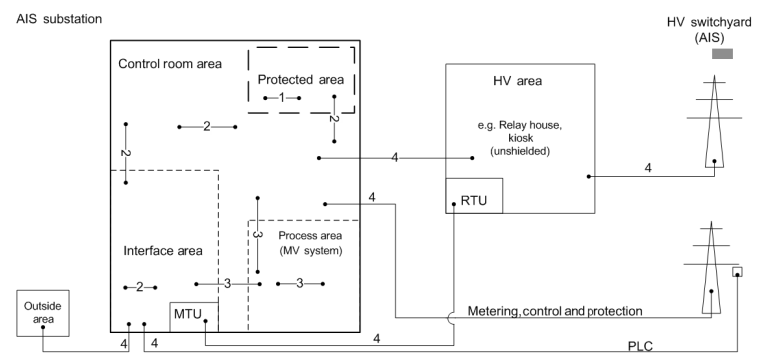
EN 61000-6-5 specifically covers power station, generation, and distribution environments with specific tests reflecting the electrical stresses seen in different areas or zones within these environments. The higher the number the higher the noise levels present. An example for an Air Insulated Substation is shown below.
Special / Other
Aerospace (e.g. EUROCAE ED 14 and DO-160) and Space (e.g. ECSS-E-ST-20-07C) have specific immunity requirements reflecting the localised noise sources in such applications.
Automotive
Higher levels of immunity are called up in UNECE regulations, SAE and ISO standards, and by vehicle manufacturers internal specifications.
Military
Both DefStan 59-411 (UK) and MIL-STD-461 (US, worldwide) call up really some quite horrible immunity tests that require specific design techniques and lots of shielding to address.
Regulations
Conformity with the EMC Directive for CE marking (selling into Europe) will include the requirement to assess your equipment for immunity performance. The use of the relevant EN standard gives noise levels to which you can use to reduce your risks to EM noise in the environment interfering with your product.
Many other regulatory domains that follow the CE marking requirements including immunity.
Some regions like the USA and Canada only call up emissions testing. However, remember that immunity is a measure of product quality.
Suspected noise problem in the real world?
EM noise is environment specific so debugging can be difficult without being in the exact location where the problem has been reported.
EM noise can be time dependant. The noise generating process has to be present during any fault finding activity otherwise the problem might not be replicable.
EM noise levels are not constant or consistent. The noise might not have the same frequency or modulation from one day to the next as it may depend on other variables in the same or other systems.
EM noise is like the bogeyman: invisible and (unjustly?) blamed for everything that goes wrong.
Example: I once spent all day in a paper factory trying to diagnose an intermittent noise problem. It took 6 hours of watching a laptop screen to catch the impulse that was suspected of causing the problem. The customer made cable routing changes to the machine and we never heard back from them – hopefully no news is good news!
It can also be hard to separate the effects of noise from software bugs. Implementing re-tries, error checking, and graceful failure to safe states can alleviate some of the problems, but this is a software sticking plaster for a hardware problem.
Testing assembled products or their sub assemblies is no guarantee of noise free performance in the real world but it will significantly reduce the likelihood.
Further Reading
A useful document for understanding more about differences in electromagnetic environments is the technical report IEC TR 61000-2-5 “Electromagnetic compatibility (EMC) – Part 2-5: Environment – Description and classification of electromagnetic environments”
Why Testing?
Why do we test for EMC in general? Because, as someone observed, that “EMC is a study of all of the elements that the designer DID NOT put on the schematic”.
The response of a system to EMC noise, which is typically applied Common Mode on all conductors in a cable for instance, is not easy to predict.
EMC immunity testing is the only realistic way to establish likely performance in the field.
We are able to test the vast majority of commercial standard tests in our Bradford, West Yorkshire laboratory.
We also understand “how EMC works” and have fixed a wide range of immunity problems over the years. This isn’t a service you get from large accredited laboratories. Pairing expert consultancy with high quality test services we can fix EMC problems in hours, not weeks.